
Australia’s geographical location, at the intersection of the Indian and Pacific Oceans, gives it a strategic position in the Asia-Pacific region. It's important that sea routes connect it to Asian markets, placing it in the middle of the growing competition between the United States (US) and China. This insight examines how Australia is repositioning as a middle power in the Asia-Pacific, navigating the complex relationships between major powers, while also balancing its strong economic ties with China and its security dependence on the US.
Figure - 1
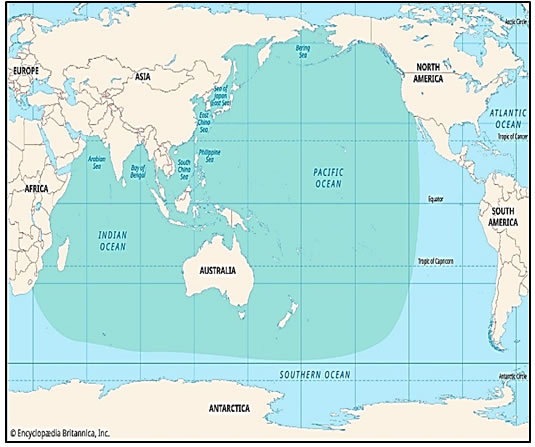
Historically, Australia, being a British settlement since 1788, is often described as Britain’s farthest outpost in Asia. Around 70% of the population being white, it has deep cultural, linguistic and institutional ties with the US, UK and other Anglo-Saxon allies. Yet, being geographically situated within the Asia-Pacific region, Canberra's security and economic environment are influenced by its proximity to major Asian powers, including China.
Australia’s diplomatic ties with Western powers are dynamic and multifaceted. Regular high-level interactions, like the Australia-US Ministerial Consultations (AUSMIN), have been the cornerstone of the relationship with the US for more than 75 years. These consultations offer a forum for coordinating positions on strategic and regional security issues, demonstrating the two states' strong diplomatic and security alignment.
Currently, Australia’s foreign policy is increasingly prioritising security and economic engagement with its regional neighbours. To reinforce its role as a middle power, it is pursuing a regional multilateral strategy by enhancing relations with middle powers like India, Japan, South Korea, and ASEAN. It also engages through multilateral forums such as the Asia-Pacific Economic Cooperation (APEC) and the East Asia Summit, which allow it to work with Asia-Pacific governments collectively and consolidate its influence on the regional order.
In contrast, Australia’s relationship with China has been more complex and cautious. Diplomatic ties, established in 1972, initially focused on economic cooperation; however, in recent years, security and strategic considerations have become more important.
Since 2017, Australia has expressed concerns over political influence, cybersecurity, and strategic infrastructure, culminating in the 2018 decision to ban Huawei from its 5G network. These changes reflect a move toward security-focused policy and managed competition.
Figure - 2
Source: Self-compiled
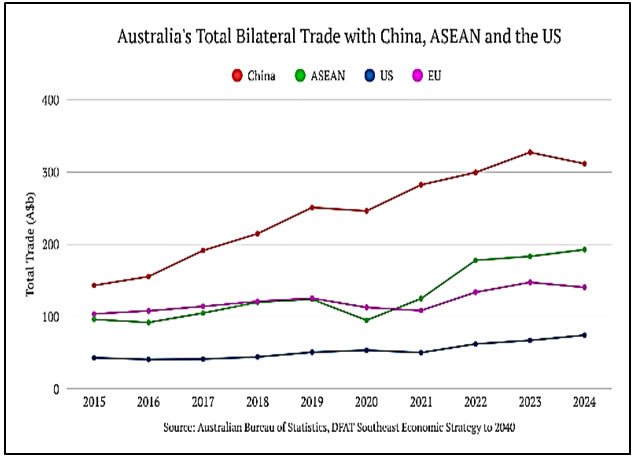
As Asia-Pacific accounts for around 60% of global trade, Australia’s economy is closely linked to the region, with China as its largest trade partner. Their economic relationship exhibits deep structural interdependence over decades (Figure 2). In 2024–25, Australia’s total trade with China accounted for approximately 25% of total goods and services trade, totalling approximately A$309 billion. Australian exports to China were about A$189 billion, equivalent to 29% of Australia’s total exports, primarily comprising iron ore, coal and LNG.
Over time, however, this relationship became more cautious, particularly after 2020 , when trade disruptions and restrictions on key exports exposed Australia’s economic vulnerabilities. In response to risks such as export concentration, economic pressure, and geopolitical shocks, Australia has increasingly focused on diversifying its economic partnerships.
Figure - 3
Source: Australian Government Department of Foreign Affairs and Trade
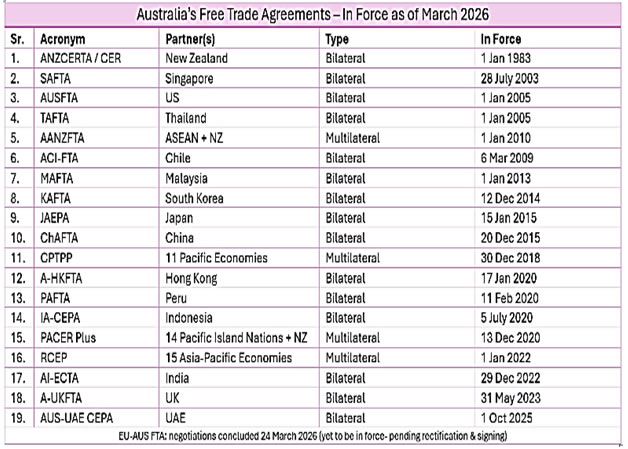
Currently, Australia is part of more than 18 free trade agreements (FTAs) covering over 30 economies, including both bilateral and multilateral deals (Figure 3). Trade with ASEAN accounts for about 15% of Australia’s total trade, making it one of Australia’s key regional partners after China (Figure 2). The European Union (EU) is Australia’s third-largest economic partner (Figure 2). In March 2026, Australia and the EU negotiated an FTA that will remove 98% of tariffs, although it is yet to be ratified. Lastly, the US accounts for around 11% of Australia’s total trade (figure 2), starkly less than China.
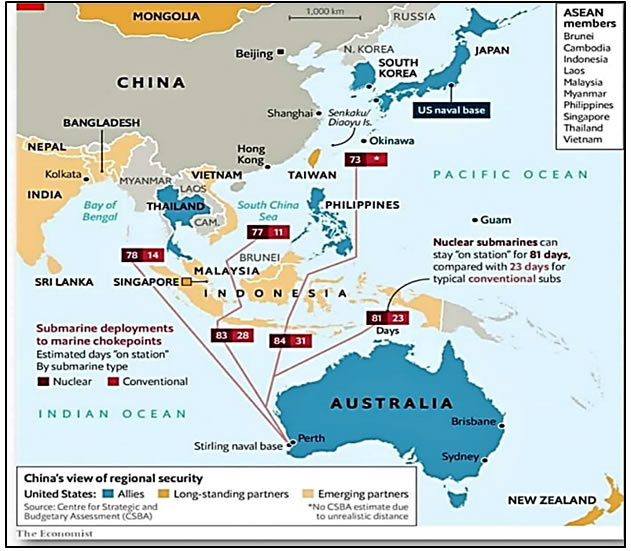
Australia serves as a key partner within the US Indo-Pacific framework, supporting its regional strategy. The US is significantly investing in Australia’s defence capabilities to reinforce its presence in the region. Simultaneously, Australia’s threat perception has evolved due to increasing competition and uncertainty in the Asia-Pacific. The 2024 National Defence Strategy of Australia focuses on a 'Strategy of Denial' to protect national interests amid a challenging Asia-Pacific environment.
Figure - 4
Source: The Economist
Firstly, Australia aims to prioritise stability in the Asia-Pacific through partnerships like AUKUS and QUAD. It gains US security guarantees and advanced military capabilities; in return, the US strengthens its strategic influence to counter China. Secondly, due to heightened escalation in the South China Sea, Australia is building deterrence to avoid trade route disruption as 30%-40% of global trade passes through the South China Sea.
Thirdly, Australia views China's naval expansion as a visible threat, observing the China’s People’s Liberation Army Navy (PLAN)’s steady progress toward a blue-water capability over the last two decades. In this way, China, despite being Australia’s largest trading partner, is viewed as a great strategic challenge.
Figure - 5
Source: The Australian
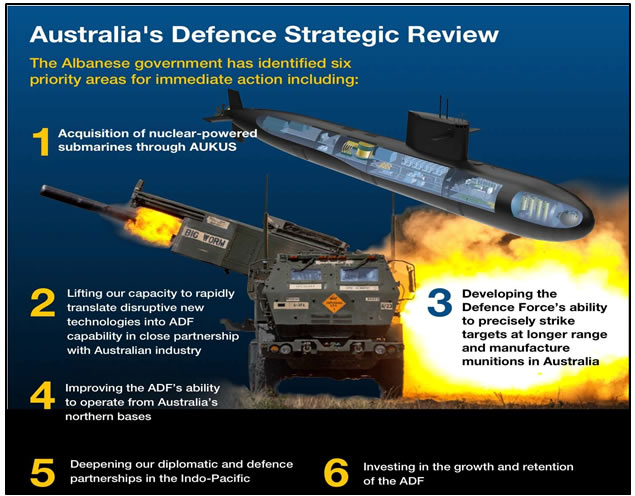
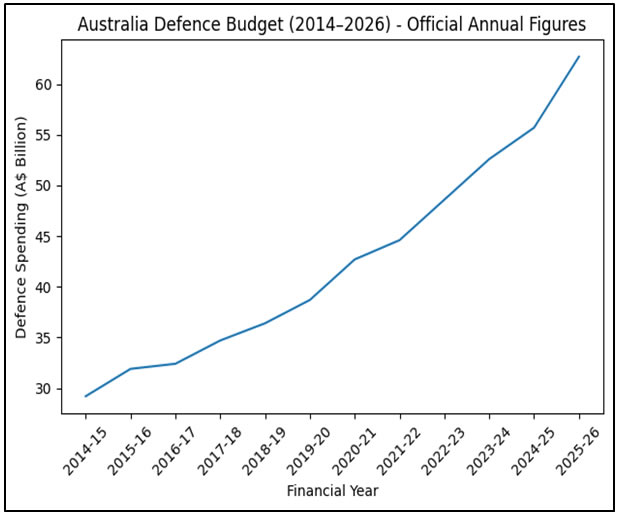
Similarly, the 2023 Defence Strategic Review outlines repositioning of Australia’s defence posture (Figure 5). Defence spending has grown substantially over the decade (Figure 6), with the 2025–26 budget estimated at around A$ 62–63 billion, an increase of 5% over the previous year, and long-term funding commitments projected at roughly A$765 billion over the next decade (Figure 6). A significant portion of this investment is directed toward maritime capabilities, with 25% of the defence budget allocated to the Royal Australian Navy.
Figure - 6
Source: Australian Bureau of Statistics
Under AUKUS, US and UK nuclear-powered submarines are expected to be deployed in Australia from 2027, while Australia plans to build its own submarines in the early 2030s. This is supported by a A$3.9 billion upgrade of the Osborne shipyard. These investments are also connected to alliance expectations. The US has clearly asked its partners in the Asia-Pacific to increase their own defence spending.
After years of supporting the US in the Middle East and Afghanistan, Australia is now refocusing its military and economic priorities toward asserting itself as a middle power in the pivotal Asia-Pacific region. It is important for Australia to distinguish its national interests from those of its allies to avoid unintended strategic entanglements in future conflicts.
In sum, Australia operates in an Asia–Pacific defined by rising US–China rivalry. In response, Canberra is attempting to assert itself as a middle power by recalibrating its defence posture, economic diversification, and coalition building with other middle powers, while simultaneously maintaining ties with its largest trading partner, China, and sustaining its alliance with its biggest security partner, the US.