The 28 February 2026 US-Israeli War against Iran, met by Iran’s closure of the Strait of Hormuz and a subsequent US naval blockade, struck at a transit relationship the five Central Asian republics (CARs) had spent a decade building around Iran’s Persian Gulf outlets—the INSTC corridor and the ports of Chabahar and Bandar Abbas.
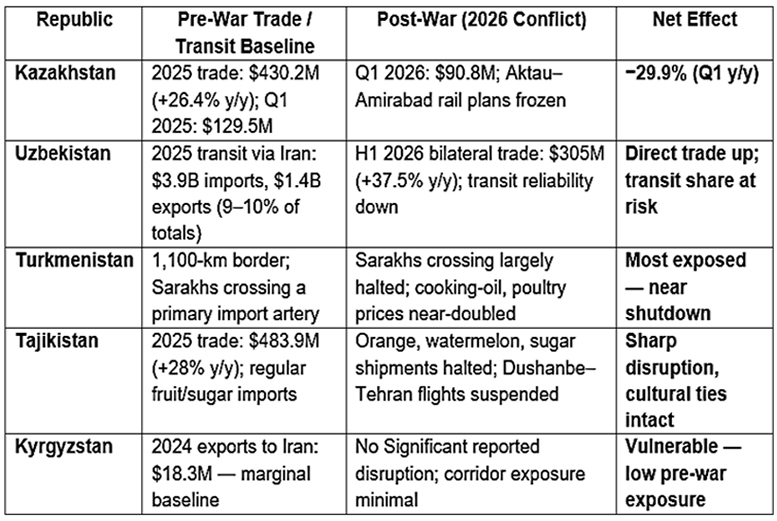
Kazakhstan’s bilateral trade, up 26.4% to $430.2 million in 2025, fell 29.9% to $90.8 million in Q1 2026, as Astana froze its Aktau–Amirabad rail plans.
Uzbekistan’s $3.9 billion in Iran-routed imports and $1.4 billion in non-gold exports proved resilient bilaterally—direct trade rose 37.5 % to $305 million in H1 2026 —even as transit reliability fell.
Turkmenistan, sharing a 1,100-kilometre border, was hit hardest: the Sarakhs crossing largely halted, and cooking-oil and poultry prices nearly doubled.
Tajikistan’s $483.9 million 2025 trade (up 28%) gave way to halted fruit and sugar shipments and suspended Dushanbe–Tehran flights.
Kyrgyzstan, with 2024 exports to Iran of only $18.3 million, stayed least exposed, its Iran trade always marginal beside its China and Russia corridors.
The disruption is uneven, not uniform. Kazakhstan’s rail corridor did not stop but grew costlier: after the April blockade, freight rates climbed roughly 40% even as train frequency rose.
The INSTC’s Caspian branch—Russia–Iran via Astrakhan, bypassing Hormuz—grew 68% in early 2026.
Losses concentrate in the southern, Hormuz-dependent legs, not the northern land and Caspian routes.
The World Bank cut its 2026 Central Asian growth forecast to 2.1 from 2.4%; regional inflation hit 8.1% in February 2026—the highest in Europe and Central Asia, and the WTO cut global merchandise trade growth to 1.9 from 4.6%. CARs are already courting CPEC and Karachi/Gwadar as hedges against Iranian volatility —an opening Pakistan has yet to pursue systematically.
Among ECO members — Pakistan, Iran, Türkiye, the five CARs, Georgia, and Armenia —TIR carnets underpin nearly all formal overland trade: ECO accounts for over 70% of TIR carnets issued worldwide, with Uzbekistan, Iran, and Türkiye the largest issuers.
Pakistan is the fastest riser rather than the largest user, with TIR operations up 200 % year-on-year through 2025–26 on new corridors linking South Asia to Central and West Asia, China, and the Middle East, cutting transport times up to 80% and costs up to 50%. CARs remain the most consistent volume users, with Türkiye and Iran anchoring the network’s western end.
With Iran effectively blocked, landlocked CARs shifted decisively to the Türkiye-centred Middle Corridor, now delivering Europe–Asia cargo in roughly 15 days; Trans-Caspian volume hit 4.5 million tonnes in 2024, a fivefold rise in seven years, with Kazakh–Turkish rail cargo up 35% in 2025 behind a $15 billion trade target. Türkiye entered the crisis with an operational, multimodal corridor and simply absorbed diverted volume.
Pakistan gained a smaller but sharply rising share: Gwadar handled roughly 11,000 TEUs in April 2026 alone—exceeding all of 2025 (8,300 TEUs)—after Islamabad formalised six overland routes to Iran and onward to Central Asia under SRO 691/2026, cutting Gwadar–Gabd transit time by up to 87% and cost by 45–55%.
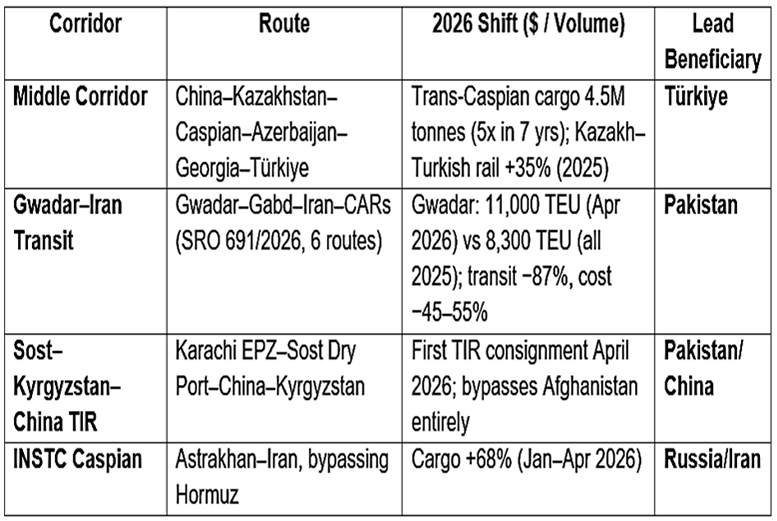
Türkiye has taken fuller advantage of Iran’s blockade than Pakistan: its corridor was already built and running, while Gwadar’s approach channel remains dredged to roughly 12.5 of a designed 14 metres, with no permanent shipping line yet scheduled to call.
The opportunity is nonetheless real—Gwadar and the Sost–Kyrgyzstan–China TIR route give CARs a second southern sea access, and demand for Hormuz alternatives is unlikely to fully reverse. The constraints are equally concrete: port depth and hinterland rail, thin Iran-linked banking channels under sanctions exposure, and a Balochistan security environment raising insurance and transit costs.
Pakistan did not neglect the Afghan route by choice —it closed Torkham and Chaman in October 2025 after terrorist attacks from Afghan territory, cutting Pakistan–Afghanistan trade from $2.46 billion in 2024 to $1.77 billion in 2025 and costing exporters an estimated $177 million a month. That closure pushed Islamabad toward the Iran and Sost-China routes now driving Gwadar’s growth.
Reopening APTTA would restore a shorter route to Central Asia than either detour. However, Afghan transit is presently conditional on verified security guarantees, not an immediate substitute for routes already being built.
Pakistan needs to consolidate SRO 691/2026 into a permanent transit regime, and accelerate Gwadar dredging to its designed 14 metres to attract scheduled shipping lines. There is a need to pursue a sanctions-insulated Iran banking and insurance arrangement to secure the Gwadar–Gabd corridor’s gains.
Pakistan must encourage CARs to lock in TIR volume toward Gwadar and Karachi through guaranteed transit pricing.
Absent these steps, Türkiye—not Pakistan—will remain the principal beneficiary of Iran’s blockade, despite Pakistan’s shorter route to the sea.
Recent Insights


The views expressed in this Insight are of the author(s) alone and do not necessarily reflect the policy of ISSRA/NDU.