
Post Cold War, the Gulf has re-emerged as a critical hub where energy security, maritime stability and intra-regional competition intersect. However the recent 2026 Iran–Israel–US escalation has heightened regional uncertainty and reinforced the strategic importance of Gulf partnerships for India. This insight examines the trajectory of India’s engagement with the Gulf, particularly the UAE, Iran and KSA and how it structures its Gulf policy post 2001 through flexible and interest-driven engagement with each partner.
The 2026 US–Israel–Iran escalation has rattled Gulf security, with Iranian retaliations and Strait of Hormuz tensions forcing regional states to diversify partnerships. In this volatile climate, India’s diplomacy with the UAE and KSA has shifted from purely economic to vital strategic cooperation while complicating India’s engagement with Iran.
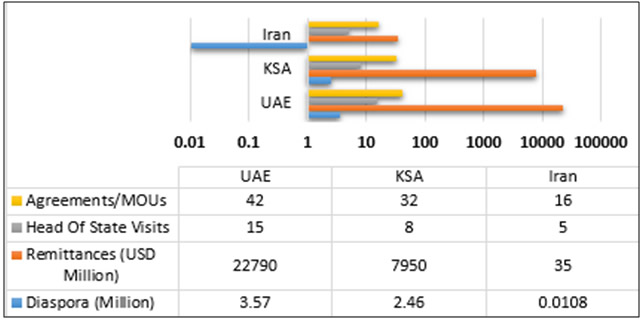
India's diplomatic trajectory with the UAE illustrates a shift from situational engagement to sustained political alignment. Relations with the UAE, established in 1972, gained strategic momentum after PM Modi’s 2015 visit, the first in 34 years. Since then, repeated high-level engagements, including PM Modi’s Feb 2024 visit and UAE President Sheikh Mohamed bin Zayed’s January 2026 visit to India, demonstrate sustained political alignment. Moreover, a 3.57 million-strong Indian diaspora strengthens people-centric diplomacy, supported by technical engagements such as I2U2 (India–Israel–UAE–US) and the G20. Amid the recent Iran–Israel–US escalation, India has maintained a selective stance supporting regional stability while sustaining close diplomatic engagement with the UAE and Israel.
With KSA, India shifted from energy-centric cooperation to structured political coordination. Landmark visits, such as those by PM Manmohan Singh (2010) and KSA Crown Prince Mohammed bin Salman (2019), reframed relations. The formation of the Strategic Partnership Council institutionalised diplomatic engagements. Regular ministerial and leader-level engagements through 2024–25, alongside diplomatic passport visa exemptions (2025), demonstrate deepening state-to-state trust, supported by a 2.46 million Indian diaspora. During the recent regional escalation involving Iran, India has maintained close contact with Riyadh, emphasising de-escalation and maritime stability.
India-Iran diplomacy demonstrates continuity under constraint. Foundational agreements such as the Tehran Declaration (2001) and the New Delhi Declaration (2003) continue to frame engagement, while the recent foreign minister-level consultations in Sep 2025 and the 20th Joint Commission (May 2025) sustain political dialogue.
Strategic projects like Chabahar Port anchor India’s connectivity-driven diplomacy; however, rising tensions around the Strait of Hormuz create uncertainty for India’s operations at Chabahar Port. The graph below shows India’s strongest engagement with the UAE, evolving from energy ties to a multi-dimensional strategic partnership.
Graph 1: Comparative Indicators of India’s Relations with UAE, KSA, and Iran (2001-2025)
Source: Compiled by author (Ministry of External Affairs & Reserve Bank of India)
Similarly, India’s military engagement with Gulf States has expanded steadily, reflecting a strategic balancing approach rather than bloc alignment. This balancing has become more important amid the 2026 regional conflict, which highlighted the importance of security cooperation.
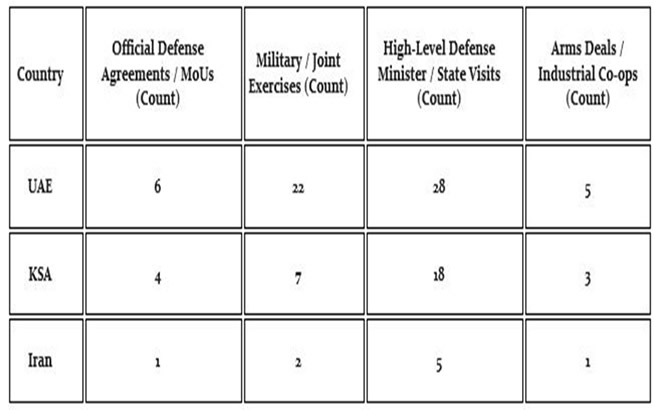
With the UAE, India’s defence engagement has evolved, moving beyond diplomatic signalling toward sustained operational and industrial cooperation. Early formalisation through the 2003 Defence MoU and Joint Defence Cooperation Committee translated into sustained exercises, culminating in expanded cooperation areas by 2025.
Defence cooperation with KSA, though initiated later, rapidly strengthened, especially after 2014. In 2024, India’s Munitions India Limited signed a major contract to supply 155mm artillery ammunition to the KSA. Joint exercises like Al-Mohed Al-Hindi, EX-SADA TANSEEQ-I (2024), and regular Joint Defence Cooperation Committee meetings reflect a shift from limited engagement to sustained operational collaboration.
By contrast, India–Iran defence cooperation remains limited to naval coordination and training exchanges, including the Indian Ocean Naval Symposium (IONS). A recent India–Iran naval exercise concluded shortly before the escalation, after which Iranian vessels were reportedly targeted by U.S. strikes, highlighting the constraints on deeper defence cooperation amid sanctions and conflict. The table below depicts India’s defence agreements, exercises, visits, and industrial cooperation with each country from 2001 to 2026.
Table 1: India’s Defence Engagement with UAE, KSA, Iran from 2001 to 2026
Source: Compiled by author (Ministry of External Affairs & Reserve Bank of India)
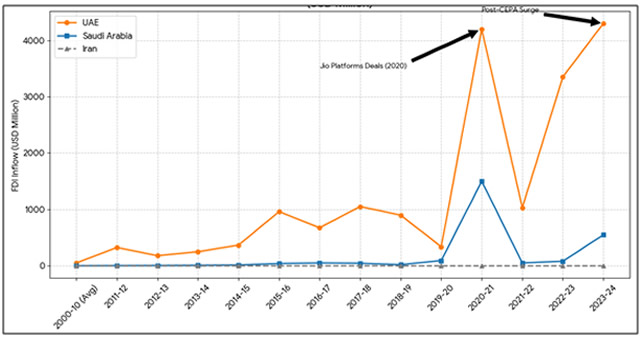
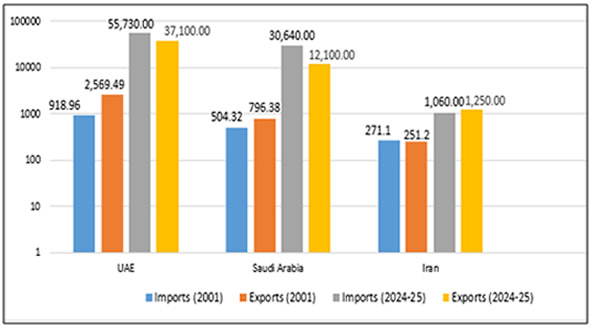
The 2026 regional crisis has increased the economic importance of Gulf partnerships for India by raising risks to energy supply and maritime trade. With the UAE, economic ties show a clear upward shift, especially after the Comprehensive Economic Partnership Agreement (2022), which institutionalised capital integration. UAE FDI in India rose to US$2.9 billion in FY 2023–24, with cumulative inflows approximately US$22 billion, while Indian investment in Dubai exceeded US$3 billion in 2024, reflecting reciprocal capital flows. Bilateral trade has steadily increased, crossing US$100.06 billion in FY25 with a 21 % year-on-year growth rate. India exports approximately US$36 billion, while imports reached US$48 billion, reflecting a clear upward trajectory as shown in the following graph. The recent escalation has reinforced India’s reliance on the UAE as a stable partner for energy, trade, and remittance flows.
Graph 2: FDI Equity Inflows into India (2000-2024) (USD Million)
Source: Compiled by author (Department for Promotion of Industry and Internal Trade (DPIIT), FDI Fact Sheet)
Saudi investment aligns closely with Vision 2030. The Public Investment Fund (PIF) committed approximately US$10 billion, which reflects long-term strategic intent. Remittances of US$13 billion further deepen ties. Bilateral trade remained US$42.97 billion (FY24), with imports (approximately US$31 billion) skewed toward crude oil and LPG. Saudi Arabia supplied 33.14 million metric tons of crude oil (FY25), underscoring energy dependence. However, exports doubled to US$11.56 billion, showing gradual diversification. The 2026 regional conflict has increased the strategic value of India–KSA economic engagement, particularly for energy security.
India–Iran investments remain geopolitically selective, centred on the US$120 million Chabahar project and a US$250 million credit line, reflecting connectivity-driven diplomacy. Once supplying 16.5% of India’s oil (2008–09), Iran’s role sharply declined. The ongoing Iran–Israel–US conflict has further strained its engagement, limiting India’s strategic cooperation with Tehran.
Graph 3: India Import & Export with UAE, KSA & Iran (2001-2025) Million USD
Source: Compiled by author (IMF & Ministry of Commerce, Govt of India, 2001-2024)
The graph above shows the UAE as India’s strongest Gulf trade partner, KSA energy-focused, and Iran limited but strategic. In the evolving Gulf order, India’s Gulf policy has shifted towards assertive engagement. While India remained silent on initial strikes on Iran, PM Modi condemned Iranian retaliatory attacks on the UAE and KSA in March 2026, signalling support for Gulf Arab sovereignty.
Prioritising the security of its energy interests in KSA and UAE, India has placed these states at the core of its strategy. The 2026 escalation highlights threats to maritime routes, energy infrastructure, and regional stability amid US security presence and rising Chinese influence. India’s calibrated engagement with the UAE, KSA, and Iran seeks to safeguard trade, energy, and human security while navigating intensifying rivalries.