
The I2U2 is a minilateral group that includes four states: India, Israel, the United States (US), and the United Arab Emirates (UAE). It is an economic and technological cooperation platform. However, the members of I2U2 also share strong defence ties and strategic partnerships, thus suggesting implications beyond economics and technology. I2U2 also carries a strategic weight as it operates in a region with shifting alignments, a fragile balance, and longstanding rivalries. I2U2 is also seen as a US-backed effort to soft-balance Chinese capital with parallel investment networks in the region.
This insight argues that I2U2 is not merely a cooperative initiative; rather, it is part of a broader geopolitical reordering that influences regional alignments and security.
I2U2, formed in October 2021, is an issue-based minilateral forum of complementary nations. The strategic foundations of I2U2 lie in the Abraham Accords, as it created a political space for broader frameworks like I2U2.
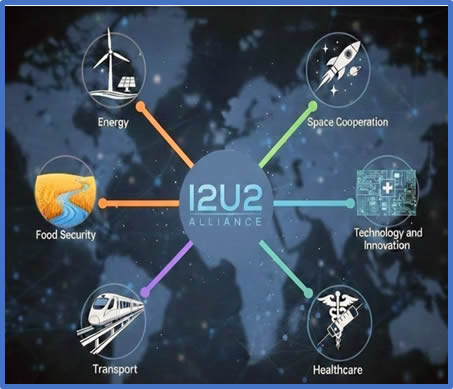
I2U2 aims to strengthen the supply chains and enhance cooperation among the member nations. It is a small partnership to turn political ties into real-time investments and development projects. It is a project-driven, flexible model that promotes private-sector cooperation and leverages existing bilateral ties. I2U2 has six focus areas, as shown in Figure 1.
Figure 1: Six Pillars of I2U2
Source: Illustrated by the Author
While framed as development-driven, these economic patterns collectively reflect growing strategic alignment through interdependence rather than formal alliance.
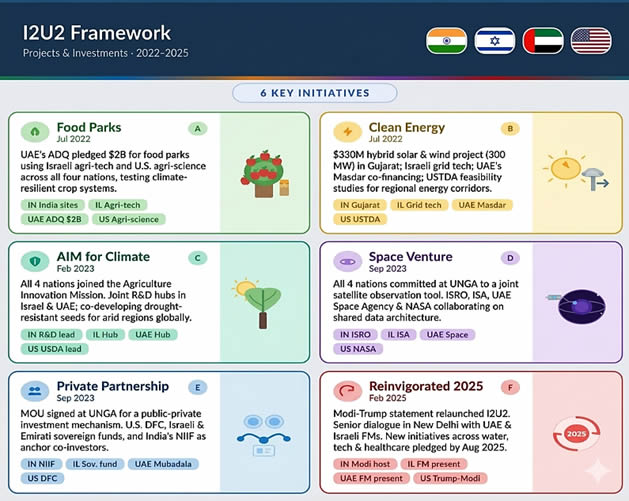
Figure 2 illustrates the key developments under the I2U2 framework from 2022 to 2025.
Figure - 2
Source: Illustrated by the Author
The two tangible projects under I2U2 are the UAE's pledge of $2 billion to build a food park in India, using Israeli and American technology to enhance agricultural productivity, reduce supply chain inefficiencies, and strengthen regional food resilience. In energy, a 300 MW hybrid renewable energy project in Gujarat, backed by joint investments, reflects a shared focus on clean energy transition and sustainable infrastructure. Other than that, all four countries joined a global farming mission called AIM for Climate, setting up research hubs to develop seeds that can grow in dry and desert conditions. Also, all four I2U2 countries at the UN are to build a joint satellite network to observe Earth.
Analysing bilateral trends in trade, tourism, and defence relations among the I2U2 members outside the alliance over the last ten years (2016-2025) provides a clear picture of pre- and post-I2U2 (2021) developments in these sectors.
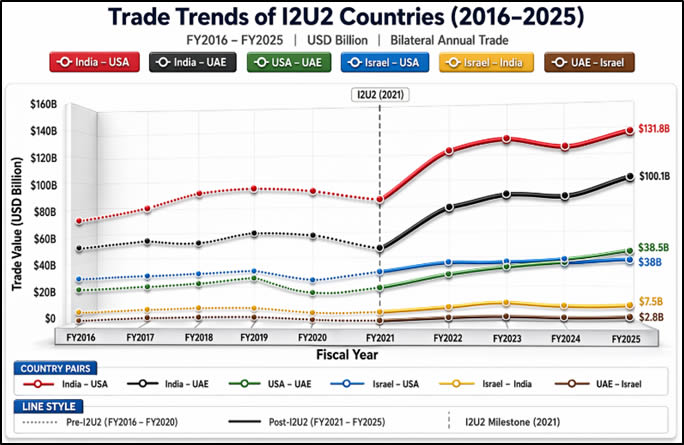
Graph 1 shows the overall bilateral trade volume, in billions of dollars, between all I2U2 members over the past 10 years (2016-2025). Bilateral trade declined in 2019 due to the COVID-19 pandemic. Since the formation of I2U2 in 2021, all countries have observed a visible boost in bilateral trade, indicating a trend of increased economic cooperation among I2U2 member states.
Graph – 1
Source: Illustrated by the Author
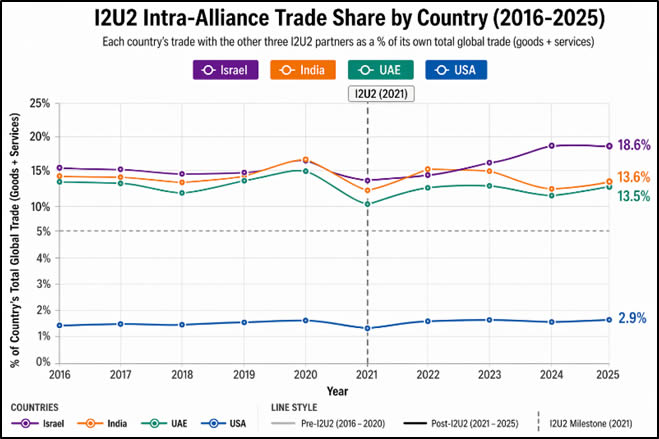
Graph 2 illustrates the I2U2 intra-alliance trade share percentage by country from 2016 to 2025. As of 2025, Israel tops the graph with 18.6% of its total trade with the I2U2 countries; then come India and the UAE, with around 13.5% of their trade with the I2U2 countries; and at fourth is the US with 2.9% trade with the I2U2 countries.
Graph – 2
Source: Illustrated by the Author
India tops the graph, with bilateral trade reaching $130 billion and $100 billion with the USA and the UAE, respectively, in 2025. The USA is India's top trade partner, and the UAE is the 3rd-largest trading partner after China.
USA trade with both Middle Eastern partners, Israel and the UAE, stands at around $38 billion in 2025. While Israel’s trade with India is at $7.5 billion in 2025. The UAE is currently Israel's leading Arab trade partner (trade began following normalisation after the Abraham Accords), and bilateral trade between the two countries is growing, especially since the formation of I2U2 in 2021. Both countries aim to increase trade to $10 billion by 2030.
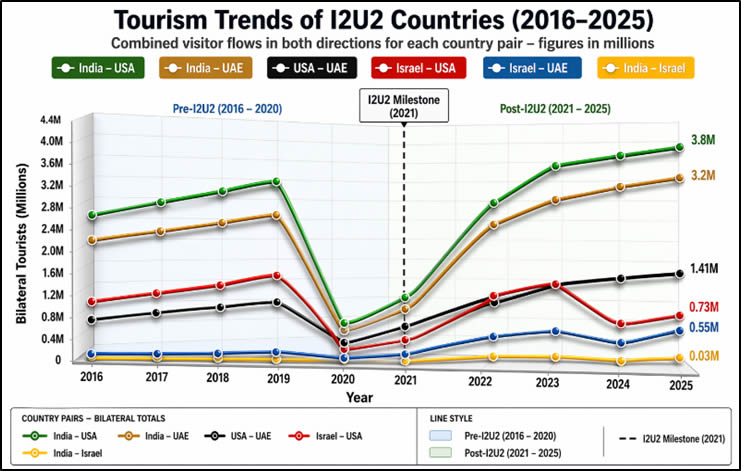
Graph 3 illustrates tourism trends among the I2U2 countries, showing the combined number of visitor flows from 2016 to 2025. Tourism took a hit due to COVID-19 in 2019, but a clear increase was seen in 2021, indicating a positive trend in tourism post-I2U2.
Graph – 3
Source: Illustrated by the Author
India tops the chart with 3.8 million bilateral visits with the USA and 3.2 million with the UAE. USA bilateral visits with the UAE and Israel stand at 1.4 million and 0.7 million. Israel’s bilateral visits have decreased due to the ongoing Gaza conflict, but are now increasing as the bilateral visits with the UAE are 0.5 million and merely 35 thousand with India.
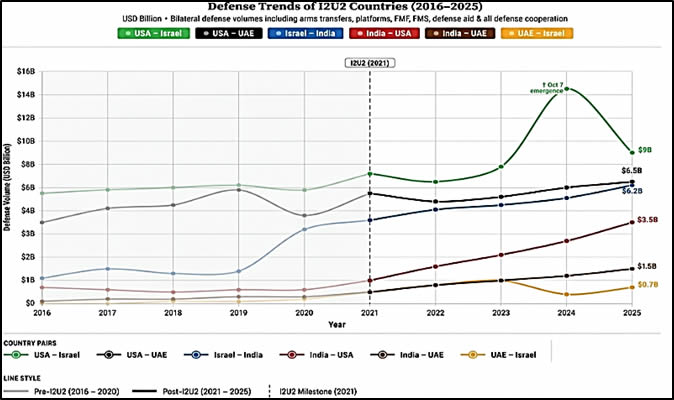
Graph 4 shows bilateral defence trade trends among the I2U2 countries from 2016 to 2025. The USA is the world's top arms exporter, and India is the world's top arms importer. The graph shows a clear increase in bilateral defence trade among the I2U2 states post 2021. The US bilateral defence trade with Israel stood at $9 billion and with the UAE at $6.5 billion in 2025. India’s defence trade with Israel and the USA stands at $6.2 billion and $3.5 billion, respectively.
Graph – 4
Source: Illustrated by the Author
Israel and the USA are its 3rd and 4th largest defence partners, respectively, behind Russia and France. While India’s defence trade with the UAE is $1.5 billion in 2025, Israel's defence trade with the UAE is $0.7 billion.
In essence, I2U2 can be seen as part of a broader US geopolitical strategy to counter China’s growing economic influence through geostrategic means rather than direct economic competition. While I2U2 has an economic facade, it is also seen as a geostrategic tool of the US in the West Asian region, like QUAD and AUKUS, and it also helps align key regional players with US interests. Recent developments, particularly the U.S–Israel–Iran conflict, also highlight how such groupings can reflect strategic convergence among members.
The expanding trade, rising investments, converging foreign policies, and deepening security ties among member states show the initiative operates within a broader geopolitical framework, not just economically. These developments highlight the need to navigate emerging alignments while protecting strategic interests and regional stability.