Pakistan’s economic structure is characterised by a dualism between a heavily regulated formal sector and a huge informal sector. The informal economy refers to economic activities that remain outside formal taxation, registration, and labour regulation, including small retail, agriculture, construction, and self‑employment. In a country where governance deficits, regulatory overreach, and political instability constrain formal enterprise, the informal economy appears not as an anomaly but as a structural necessity.
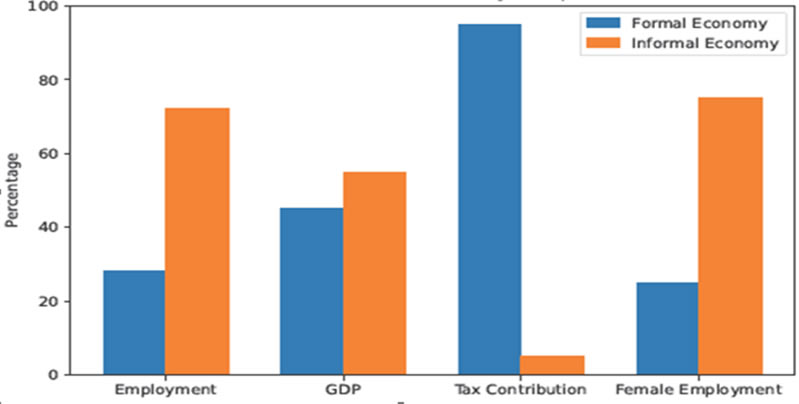
This Insight examines how Pakistan’s informal economy sustains livelihoods and mitigates deeper crises of the formal sector. With a population exceeding 250 million, Pakistan faces high unemployment, underemployment, inflationary pressures, and balance-of-payments crises. In this context, the informal economy accounts for 72% employment (Graph 1) and serves as a survival mechanism, sustaining livelihoods and ensuring household consumption when the formal sector is unable to absorb labour.
Graph 1: Comparison of Format and Informal Economy
Source: Pakistan Labour Force Survey
Empirical studies show the magnitude of Pakistan’s informal economy. Estimates by the International Labour Organisation (ILO) and national researchers place its size between 35-40% of GDP, with some scholars suggesting contributions as high as 59% when measured in local currency. Although estimates vary due to measurement methods, this suggests that a substantial portion of Pakistan’s real economic activity remains unreported in official records.
The informal economy employs nearly 75% of the non‑agricultural workforce, making it the primary source of employment for many Pakistanis (Graph 1). Agriculture, which employs 37% of the population, operates largely through informal labour arrangements. From wholesale markets to transport hubs and home-based units, informal activity underpins everyday economic life. While often criticised for weak productivity and tax leakage, informality persists largely due to high compliance costs, inconsistent regulation, and rent-seeking behaviour discouraging formalisation. In this sense, the informal economy reflects institutional failure rather than individual choice.
The informal economy plays a decisive role in job creation and poverty mitigation. In periods of low growth, it absorbs labour displaced from the formal sector and provides entry‑level opportunities for youth, migrants, and women. Home‑based work in garments, food processing, and handicrafts has been crucial to female labour participation, directly contributing to household income and food security.
The World Bank has noted that informal earnings are often more resilient than formal wages during downturns. Flexible working hours, with diversified income sources, allow informal households to smooth consumption and avoid extreme poverty. In the absence of comprehensive social protection, the informal economy effectively substitutes for a weak welfare state.
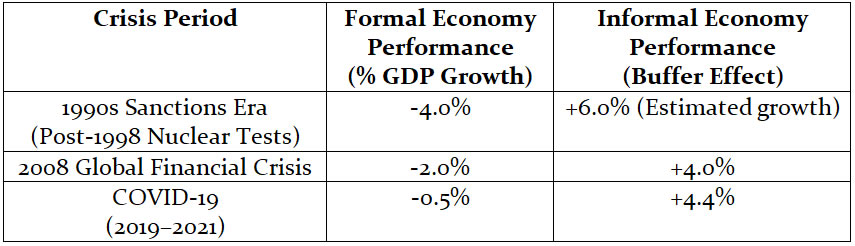
Pakistan’s reliance on the informal economy becomes most evident during periods of crisis. During the economic stagnation of the 1990s, marked by sanctions, fiscal stress, and low investment, the informal sector expanded, cushioning employment losses in manufacturing and public enterprises (Table 1).
Table 1: Economic Growth during Crisis Period
Source: Self-extracted
Similarly, during the 2008 global financial crisis, Pakistan experienced declining exports, capital outflows, and rising unemployment. Yet the informal economy mitigated the social impact. As noted by the ILO, countries with large informal sectors, including Pakistan, exhibited greater labour‑market absorption capacity, allowing workers to shift into self‑employment, petty trade, and casual services rather than remaining unemployed.
More recently, during COVID‑19, informal networks played a central role in community‑level recovery, supplying goods, labour, and services when state responses were delayed or insufficient.
Critics point to the costs of informality, including foregone tax revenues, poor working conditions, low productivity, and limited access to finance. However, premature or coercive formalisation risks destroying livelihoods without creating alternatives. The informal economy exists because formal systems are exclusionary, not because informal actors reject legality.
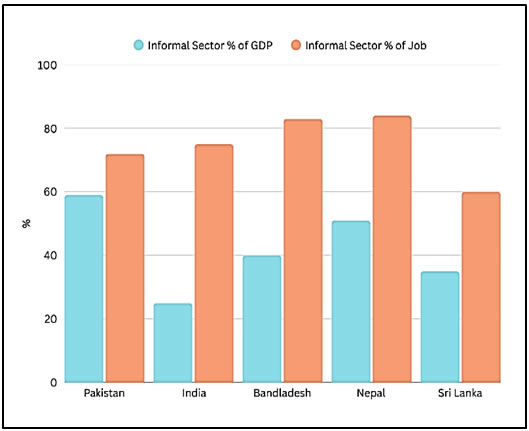
A brief regional comparison (Graph 2) shows that Pakistan’s informal economy mirrors broader South Asian patterns, in which it is a dominant source of employment in India and Bangladesh.
Graph 2: South Asian Pattern in Informal Economy
Source: ILO
Pakistan’s informal economy is not merely an unregulated residual but a core pillar of socioeconomic resilience. In an environment that constrains formal‑sector growth, informality sustains employment, stabilises consumption, and prevents social breakdown during crises. From sanctions in 1990s to the 2008 financial crisis and Covid-19, it ensured that millions continue to put food on their tables.
Rather than viewing the informal economy as an obstacle to development, policymakers should recognise it as a strategic asset, one that buys social stability before deeper institutional reforms take root. Pakistan can adopt a transitional rather than punitive approach toward informality.
Priority measures should include simplified registration, tiered taxation, access to microfinance, and digital payment systems. These steps can raise productivity without undermining flexibility. Governance reform, regulatory predictability, and trust‑building remain prerequisites for meaningful formalisation.