
This insight maps the current legislative framework (federal and provincial) for persons with disabilities (PWDs) in Pakistan, focusing on digital accessibility, identifies sectoral policies, and proposes a way forward to harmonise legislative provisions into providing actual benefit to PWDs.
Digital accessibility ensures that citizens with disabilities can access websites, apps, and online services independently—using screen readers, captions, keyboard navigation, or simplified interfaces. In Pakistan, the right to access information is already recognised through constitutional guarantees and federal/provincial disability rights laws; however, it has not standardised how that right must be delivered to PWDs so they can benefit from digital technologies and are not left behind.
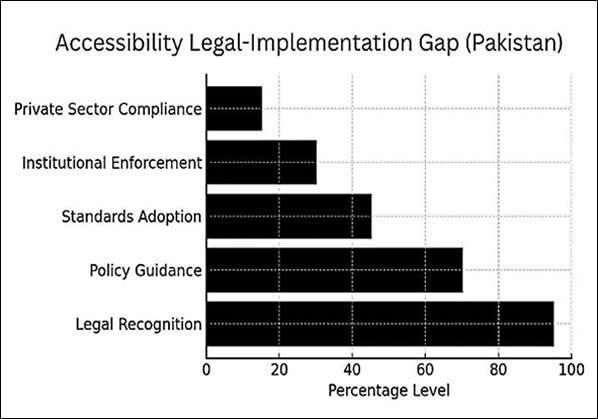
Source: Author’s analysis using Pakistan’s federal and provincial disability legislations and the UNESCAP Digital Accessibility Maturity Model (2022)
Despite constitutional guarantees and multiple federal and provincial statutes recognising accessibility and equality, Pakistan’s legislative framework stops short of operationalising these rights.
Most laws acknowledge digital access in principle but fail to define enforceable technical standards, institutional responsibility, or compliance mechanisms. This disconnect between ‘legislative recognition and legislative implementation’, creates a structural gap.
This gap is not theoretical. When a blind citizen cannot submit an online tax form because buttons are unlabeled for screen readers, their equal right to engage with the state is denied. When a deaf citizen cannot access a televised government announcement due to a lack of captions or transcripts, public information is effectively inaccessible. When someone in a wheelchair cannot operate a kiosk or digital banking terminal, financial exclusion follows. These barriers are avoidable: accessibility standards exist precisely to prevent such outcomes.
The most widely accepted accessibility benchmark is the Web Content Accessibility Guidelines (WCAG), which defines success criteria—at Levels A, AA, and AAA—for enabling access for people with visual, hearing, mobility, and cognitive disabilities. Although Pakistan’s laws mandate accessibility, none of the current statutes explicitly reference WCAG or any other technical standard. As a result, compliance remains voluntary and is therefore weak across government and private-sector services.
International experience, particularly from the UK, EU, and US, demonstrates that accessibility succeeds only when technical standards are built into every stage of digital service delivery. The leading nations operationalise inclusion by making captioning, sign-language interpretation, screen-reader optimisation, tactile feedback, and simplified mobile interfaces standard features across public services. Transit apps, health portals, and government forms are standard-conformant by design, enabling independent use without requesting assistance.
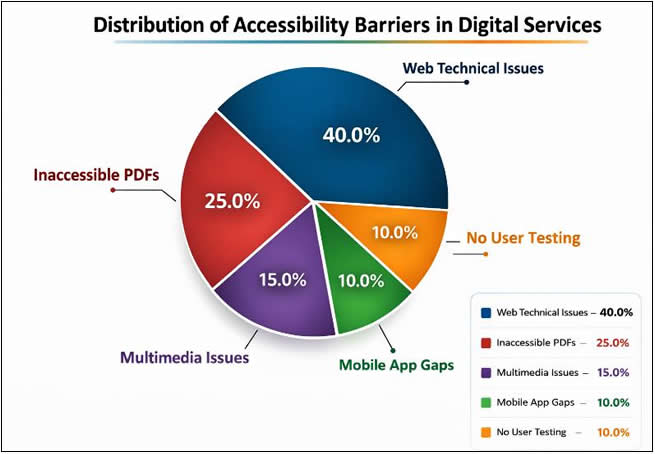
Source: Based on aggregated findings from global accessibility benchmarks, including WebAIM’s “WebAIM Million Report 2024,” and validated against global assessment frameworks such as the G3ict “DARE Index 2020
The following table maps Pakistan’s current legislative and policy landscape, highlighting how each instrument supports digital accessibility.
Table 1: Pakistan’s Legislative and Policy Instruments Relevant to Digital Accessibility
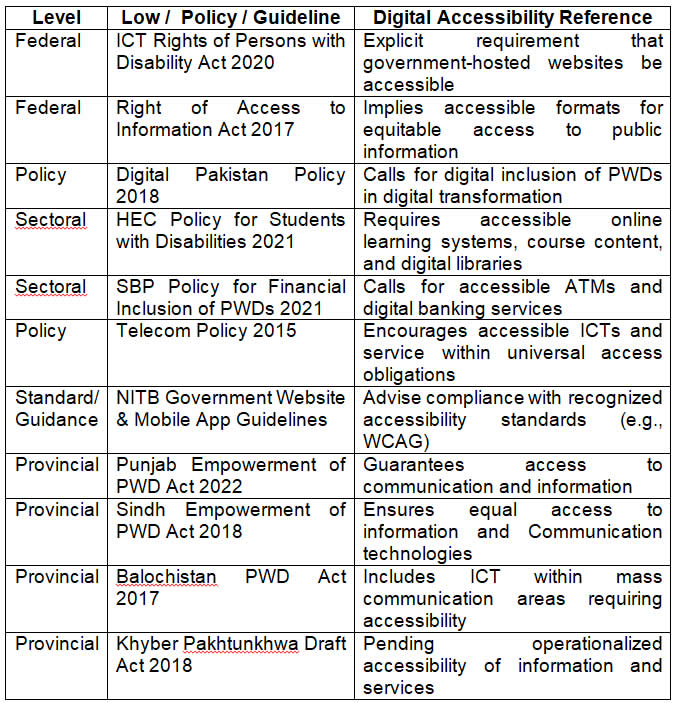
Source: Author’s analysis and compilation based on Pakistan’s federal and provincial disability legislation, ICT policies, and regulatory guidelines
A review of the above legislation and policies proves that despite strong legislation, Pakistan continues to face significant implementation barriers:
- Limited technical capacity and low awareness among developers and content creators, leading to systems not designed with accessibility in mind.
- No centralised enforcement or routine accessibility audits.
- Minimal oversight of private-sector compliance.
- Local-language content is often inaccessible to people with blindness/screen reader’s users of screen readers.
These barriers result in direct exclusion: inaccessible job portals lead to lost employment opportunities; inaccessible banking apps create financial barriers; and inaccessible public information suppresses civic participation.
Digital accessibility is not only about websites. Accessible documents and multimedia are equally critical because government communication increasingly relies on downloadable PDFs, scanned files, and video. The international standard PDF/UA (ISO 14289-1) ensures that PDFs are tagged and compatible with assistive technologies. Meanwhile, ISO/IEC 30071-1 provides a governance framework to embed accessibility across procurement, software development life cycles, testing, and maintenance. Pakistan does not yet use any of these standards in public procurement criteria—a major gap, since accessibility must be built at project inception, not retrofitted.
Standards matter for various reasons. Many countries, such as the USA, UK, EU, and even India, require WCAG 2.1 or 2.2 AA compliance in their public-sector web regulations. Linking Pakistan’s legislative obligations—such as those in the ICT Rights of Persons with Disability Act 2020—to WCAG would remove ambiguity and give government teams and contractors a clear compliance checklist. It would also reinforce accessibility as a technical requirement, not just an aspirational policy.
Accessibility requirements are increasingly embedded across major Western markets, including the European Union, the United States, the United Kingdom, and Canada, where digital products and services are subject to binding accessibility obligations. This trend has direct relevance for Pakistan, as its expanding IT and software export sector increasingly supplies digital products to these jurisdictions. Aligning Pakistan’s national accessibility framework with international benchmarks such as WCAG therefore carries not only human rights value but also clear economic and trade significance by enabling market access and regulatory compliance.
It may be considered that WCAG has already become Pakistan’s de facto standard because no alternative national accessibility framework exists. The National IT Board’s website and app guidelines, as well as some capacity-building programs, encourage adherence to WCAG.
The recent approval of WCAG 2.2 as ISO/IEC 40500:2025 now enables Pakistan Standards and Quality Control Authority (PSQCA) to formally adopt these standards, a move that would give WCAG official status in Pakistan’s legislative and regulatory system.
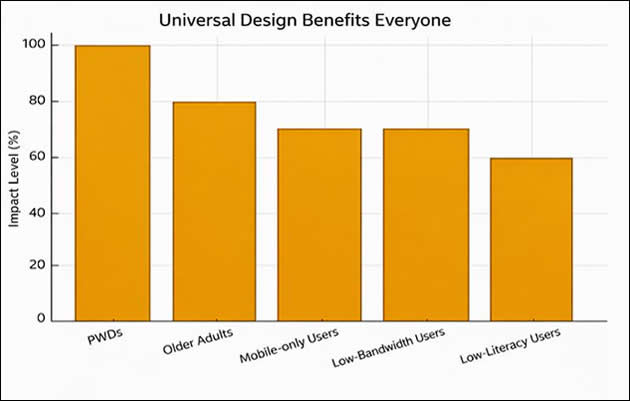
Source: Drawn based on data from W3C Web Accessibility Initiative (2023), Microsoft Inclusive Design Toolkit (2022), and GSMA Mobile Internet Skills Training Toolkit (2022), supplemented with comparative insights from WebAIM’s global accessibility findings (2024) and the G3ict DARE Index 2020
Pakistan has strong foundations—it now needs precision and accountability. Standardisation is the bridge between rights guaranteed on paper and rights experienced online. Pakistan must:
- Formally adopt WCAG 2.2 AA, PDF/UA, and ISO/IEC 30071-1 at national and provincial levels.
- Integrate accessibility requirements into procurement and funding for every digital government project.
- Build practical education and skills within ministries, regulators, and development teams about digital accessibility.
- Introduce audits, transparency dashboards, and enforceable remediation timelines.
- Ensure that Persons with lived experience of disabilities are involved not only in testing and auditing, but across the digital service lifecycle—including policy formulation, procurement design, implementation, and evaluation – consistent with the UNCRPD (United Nations Convention on the Rights of Persons with Disabilities) principle of “nothing about us without us.”
These actions are neither costly nor complex—they are standard practices globally. By standardising delivery, Pakistan can finally fulfil what its legislation promises: a digital state that serves all citizens with dignity, independence, and equality.